

The Measure of a Life
Michael Shermer ponders the question of what the measure of a life is once it has gone. And if that life was an epochal-shaping life, how is a contemporary biographer to put that life in perspective before the epoch is over?

Solen discovered The Demon-Haunted World on the library shelf one day. He had heard of Sagan, of course, but knew little of him. At a time when Solen’s friends had left him, where he could not confide in his own family, the book’s dedication invited him toward the candle…
Gregory Benford recounts how Carl Sagan, the best known astronomer in the world, was turned down by the National Academy of Sciences and laments that no other widely recognized scientist has replaced him in popular discourse.
Joel Achenbach moved offices, and began to purge files, stuff he didn’t need and hadn’t looked at in years. Digging deep, he came across a fat file marked “Sagan.” The astronomer died in December 1996. Save? Throw away? From the documents, a voice emerged…
When Tom McDonough was a grad student at Cornell in the late 1960s, he ploughed through dry scientific journals. Occasionally, he found papers bordering on science fiction, hidden within them like naughty pictures. These gems were often by an obscure Harvard scientist named Carl Sagan. They spoke about the possibility of life on other worlds, a subject almost taboo in science at that time…
Carl Sagan and Edward Teller were bitter opponents in national security debates about issues such as “Star Wars” and nuclear test bans, but ironically they agreed on defending the Earth against asteroids — an agreement that neither, however, was ready to admit in public.
Carl Sagan saw a vision of human space-explorers venturing out into the universe, following the great tradition of the sailors who ventured out onto the oceans and began to explore the continents of this planet 500 years earlier. But Carl was not only a romantic visionary; he was also a professional scientist.
Culled from the expansive work of Carl Sagan, we present some of his own words on the cosmos, ETs, childhood, genes, brains, pseudoscience, science literacy, nonsense, uncertainty, biology, history and God.
James Randi’s heroes are few. Among that short list of heroes is Carl Sagan. Randi recounts how Carl Sagan, in all respects, supported science and the simple process of thinking.
As an undergraduate in the 1960s, Tom McDonough eagerly read the scientific papers of an obscure young astrophysicist named Carl Sagan — one of the few researchers investigating the possibilities of life on other worlds. McDonough shares some of his personal reminiscences of Carl Sagan.
December 20, 1996 was a gloomy day at the Skeptics Society. In light of the death of one of the finest human beings of our age, Michael Shermer pays tribute to the late Carl Sagan.
In 2008, Ben Stein created the anti-science propaganda film Expelled: No Intelligence Allowed, equating evolution with Nazism. We’ve compiled several links to various critical sources debunking the claims made in the film.
A quick reference guide of 105 Ways To Promote Skeptical Activism. The full version (PDF) comprises over 30,000 words of in-depth panel discussion, in which 13 leading skeptics offer their commentary and advice on the 105 topics. Both versions are completely free.
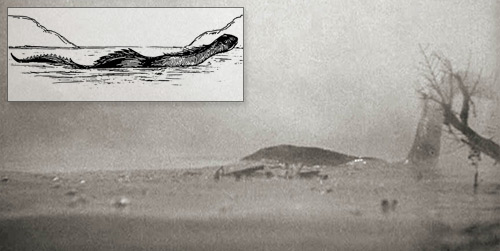
According to legend, an awesome, primeval monster — a huge serpent with flippers, a mane, and a head something like that of a camel or horse — slides undetected through the frigid waters off British Columbia and Washington State. Could a living dinosaur, a monster out of time, lurk here beneath the waves?
In this review of Mark Perakh’s 2004 book, Unintelligent Design, the mathematician Paul Gross reviews the most advanced arguments put forth by the new breed of creationists — Intelligent Design Proponents — and reveals Perakh’s devastating deconstruction of these arguments, such as irreducible complexity, the “design inference,” and information theory.
In this review of Dick Teresi’s Lost Discoveries, mathematician and man of letters Norman Levitt deconstructs and debunks the revisionist mythology that the ancient Greeks stole science and math from the Egyptians and other African cultures.
James Rogers reviews Darwin: The Life of a Tormented Evolutionist a biography by Adrian Desmond and James Moore on how Darwin’s life and theories cannot be properly understood if separated from the social, religious and political context that molded their expression.